Section: Biological and Biochemical Foundations of Living Systems
8)
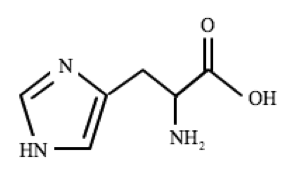
The amino acid histidine has a nitrogen-containing side chain. The pKa for the carboxylic acid group, imidazole side chain, and the primary amine has a value of 1.8, 6.0, and 9.0, respectively. Which of the following structures accurately reflects the predominate form of histidine at a normal physiological pH of 7.4?
Explanation
his question requires the examinee to apply the Henderson-Hasselbalch equation to determine the most common structure of the amino acid histidine at a normal physiological pH. pH = pKa + log[A–/HA] To answer this question, you must figure out the predominate form of each acidic substituent group. Carboxylic acid group: 7.4 = 1.8 + log[A–/HA] The logarithm of the ratio of the conjugate base to the acid must equal 5.6. That means the concentration of the conjugate base is 5.6 orders of magnitude greater (105.6) than the concentration of the acid! Thus, the carboxylic acid will be in the conjugate base form. Imidazole side chain: 7.4 = 6.0 + log[A–/HA] The concentration of the conjugate base is 1.4 orders of magnitude greater than the concentration of the acid. Therefore, the conjugate base will be the predominate form. Primary amine group: 7.4 = 9.0 + log[A–/HA] The log[A–/HA] is equal to -1.6, which means the concentration of the protonated form is 1.6 orders of magnitude greater than the concentration of the conjugate base. Accordingly, histidine will have its carboxylic acid and imidazole side chain in their conjugate base form while the primary amine will remain as neutral R-NH2. Thus, C is the correct answer.
This question is provided by
Next Step Prep.
Next Step Prep provides many resources to help you prepare for and pass your upcoming exam.